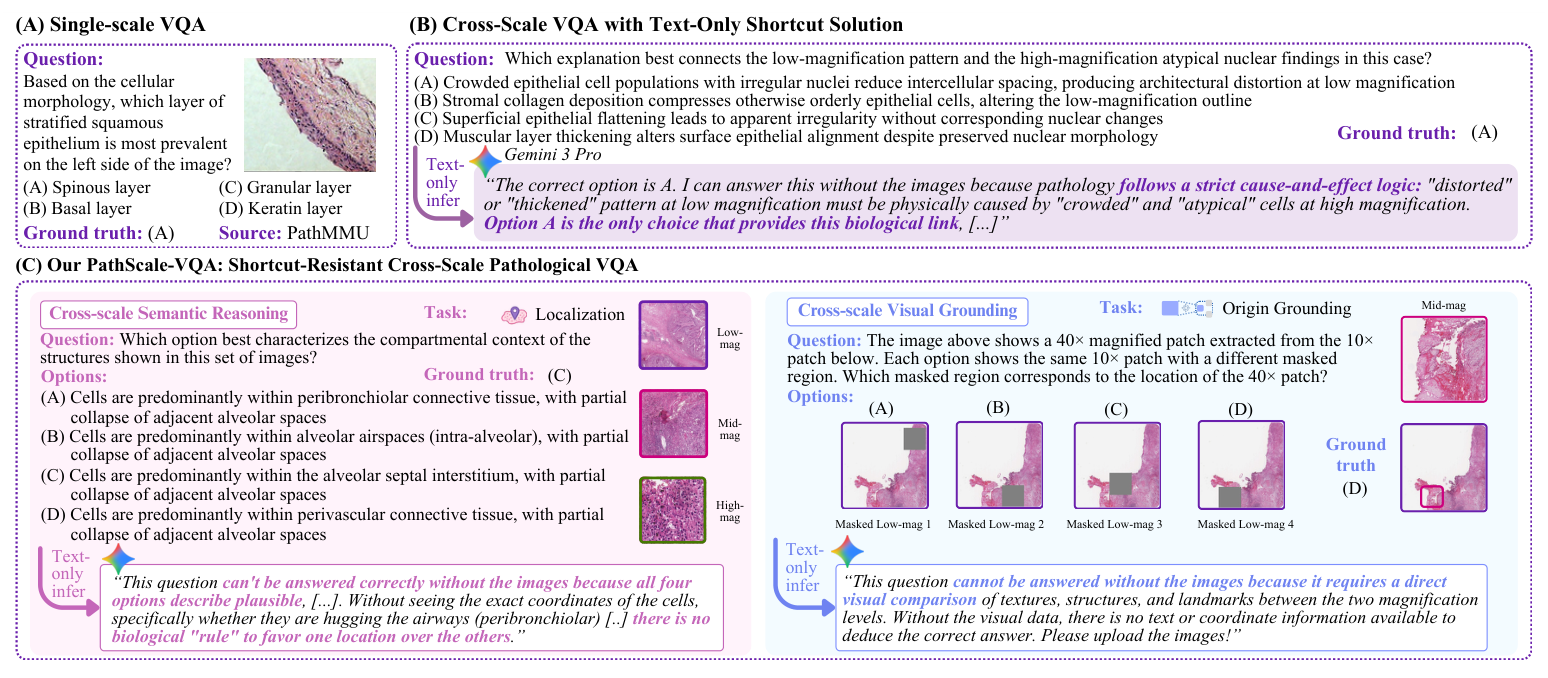
Pathological diagnosis is inherently multi-scale, requiring the integration of global tissue architecture at low magnification with cellular morphology at higher magnification. However, existing pathology benchmarks and vision-language models (VLMs) are still largely developed under single-scale settings, limiting their ability to learn clinically meaningful multi-magnification reasoning. Moreover, naively constructed visual question answering (VQA) tasks may be susceptible to text-only or superficial visual shortcuts, leading to unreliable assessments of visual understanding. To address these limitations, we introduce a benchmark and training framework for shortcut-resistant cross-scale pathology reasoning. We design an Adversarial Text-only Screening strategy for semantic reasoning questions and a Structure-controlled Distractor Sampling strategy for visual grounding questions, encouraging models to rely on cross-scale visual evidence. Based on this pipeline, we construct PathScale-VQA, a high-quality cross-scale pathology VQA benchmark with 10,373 multiple-choice questions grounded in 1,368 diagnostic paths across multiple magnification levels. Building on the semantic reasoning set, PathScale-R1 is optimized through Difficulty-driven Reasoning Distillation supervised fine-tuning followed by reinforcement learning with a Scale-aware Reasoning Structure reward, which encourages the use of evidence across magnifications. Extensive experiments demonstrate state-of-the-art performance of PathScale-R1 on cross-scale reasoning tasks and effective transfer to conventional single-scale pathology VQA.
Cross-scale questions
10,373
Verified diagnostic paths
1,368
TCGA whole-slide images
373
Organ sites
14
Figure 1. Single-scale VQA, text-only shortcuts, and the proposed shortcut-resistant semantic reasoning and visual grounding tasks.
Extends ScaleReasoner-R1 (MICCAI 2026) with a larger benchmark, five visual grounding tasks, difficulty-driven distillation, and scale-aware reinforcement learning.
02 / PathScale-VQA
Two complementary ways to test understanding.
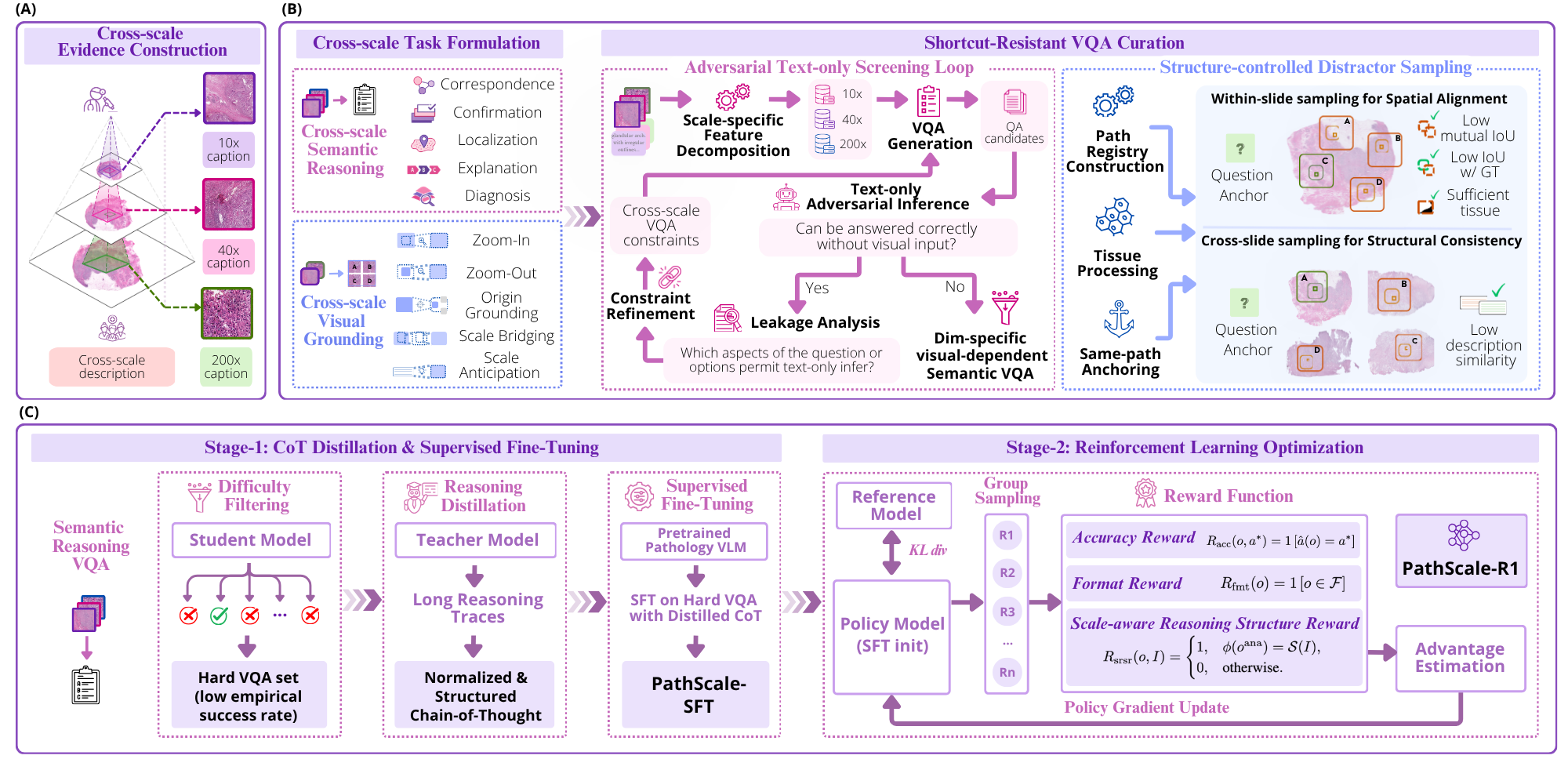
Pathologist-verified trajectories link clinically related 10×, 40×, and 200× regions from the same whole-slide image. Questions test both interpretation and visual correspondence.
Textual answer options
Semantic reasoning
6,030 questions
Interpret and integrate evidence across at least two magnifications.
CorrespondenceAssociate the same pathological process across views.
ConfirmationCheck whether another scale supports or contradicts a finding.
LocalizationIdentify where diagnostic evidence appears.
ExplanationConnect observations to justify an interpretation.
DiagnosisCombine the evidence into a final conclusion.
3,680 train/validation · 2,350 test Patient-wise WSI splits
Image answer options
Visual grounding
4,343 questions
Match regions and recover the relationships along a diagnostic path.
Zoom-In CorrespondenceFind the corresponding higher-power view.
Zoom-Out CorrespondenceFind the corresponding lower-power context.
Origin GroundingLocate a crop within its parent region.
Scale BridgingRecover the missing intermediate view.
Scale AnticipationSelect the high-power view consistent with lower-power evidence.
Evaluation only No grounding-specific training
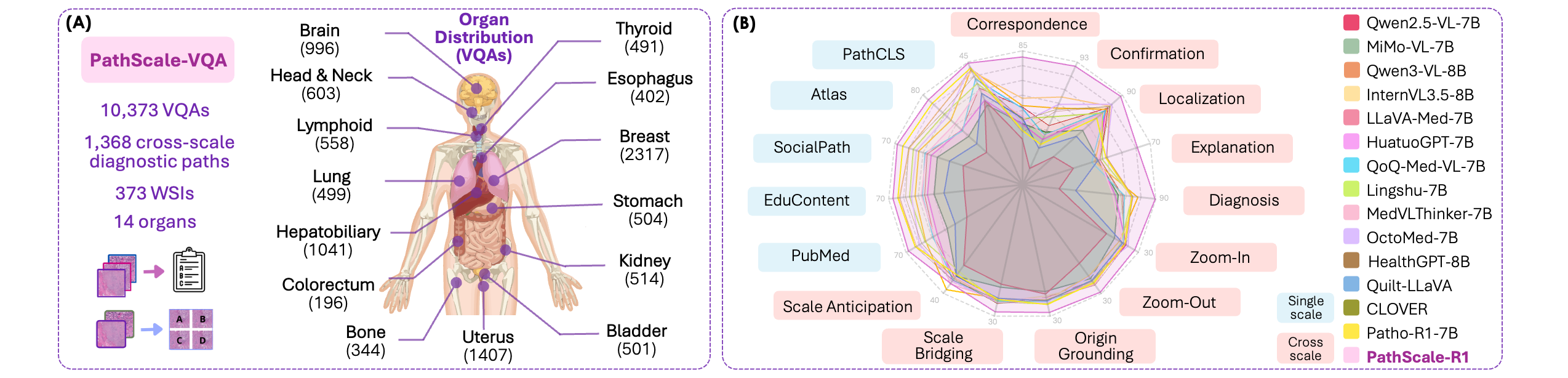
Figure 3. Dataset coverage across 14 organ sites and task-wise benchmark performance.
Shortcut-resistant curation
Make visual evidence necessary.
Textual and image options create different shortcut risks. Each task family receives a targeted curation strategy.
Adversarial text-only screening
Gemini 3 Pro and Qwen3-Max answer without images. Potentially leaked questions are revised and screened again, then reviewed by pathologists.
Structure-controlled distractor sampling
Spatial alignment distractors come from other paths within the same WSI. Trajectory completion distractors come from different WSIs, with constraints on morphology and ambiguity.
03 / PathScale-R1
Learn the structure. Refine the reasoning.
PathScale-R1 starts from Patho-R1-7B and learns on the semantic reasoning set through two complementary stages.
Figure 2. Expert-verified diagnostic paths, shortcut-resistant VQA construction, and the two-stage optimization framework.
01
Difficulty-driven reasoning distillation
Query the base model 16 times and retain questions with an empirical success rate below 25%. Distill Qwen3.5-397B rationales into compact, structured evidence analysis, then apply supervised fine-tuning.
Bold marks the best model score in each column. Tables retain every model and score from Tables I and II; second-best scores are not specially styled.
05 / Analysis
Does the model need the images?
Image removal probes the benchmark’s dependence on visual evidence. Component ablations separate the contributions of distillation, RL, and the structure reward.
Full images64.83%64.83%
Drop one55.35%55.35%
Drop two47.52%47.52%
Text only27.79%27.79%
Averages across PathScale-R1, InternVL3.5-8B, Qwen3-VL-8B, OctoMed-7B, and HealthGPT-8B. These are not scores for PathScale-R1 alone.
Image removal · Table III
Setting
Correspondence
Confirmation
Localization
Explanation
Diagnosis
Average
Full images
49.83
69.15
80.55
46.94
77.70
64.83
Drop 1 image
44.28
53.36
69.40
43.03
66.67
55.35
Drop 2 images
33.42
46.93
60.29
38.68
58.28
47.52
Text only
17.40
27.86
34.48
20.89
38.30
27.79
Training components · Table IV
Setting
Correspondence
Confirmation
Localization
Explanation
Diagnosis
Average
Patho-R1 baseline
31.49
34.68
67.23
44.04
73.62
50.21
+ SFT
58.51
83.62
81.70
50.85
82.13
71.36
+ SFT + RL, no structure reward
79.57
89.13
85.96
63.40
86.81
80.97
+ SFT + RL + structure reward
80.85
91.91
88.72
65.74
89.36
83.32
Adding the scale-aware structure reward improves average accuracy from 80.97% to 83.32% (+2.35 pp). Image-removal scores are absolute accuracies; the parenthesized drops in the paper are omitted here.
06 / Qualitative results
Read the evidence across views.
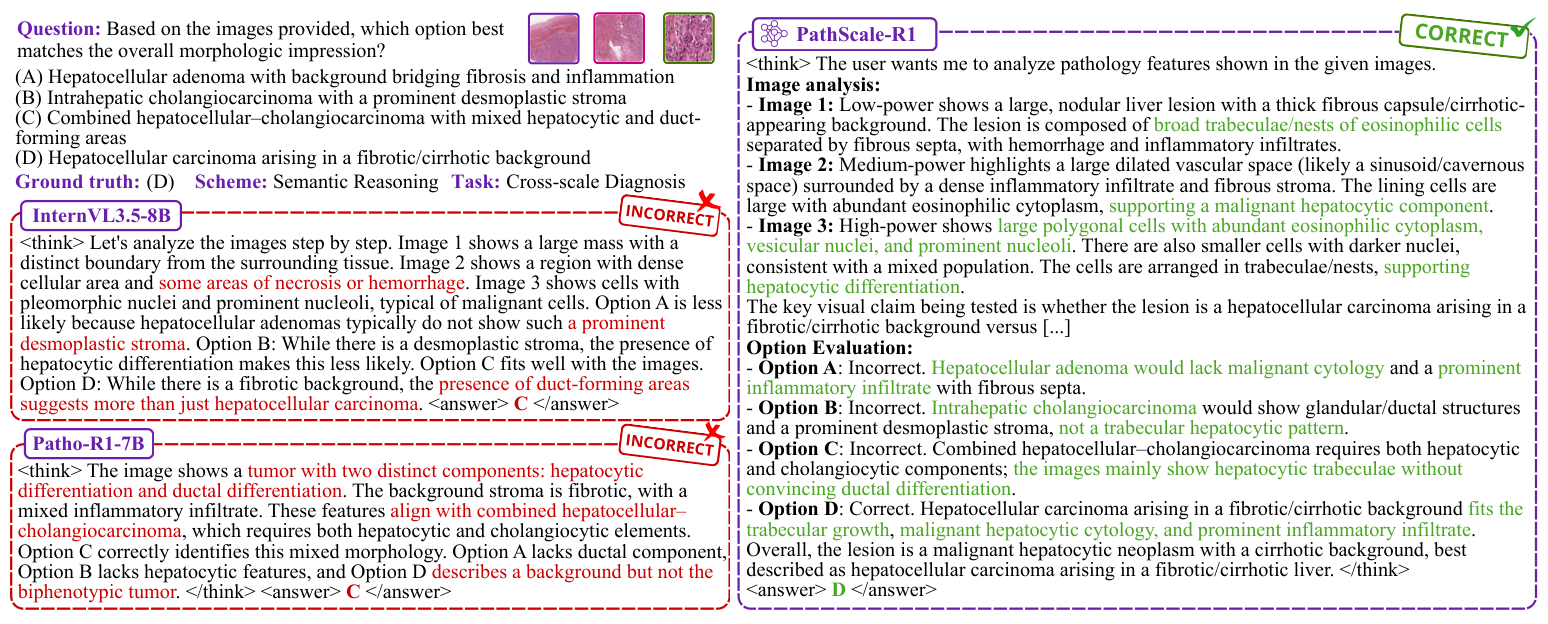
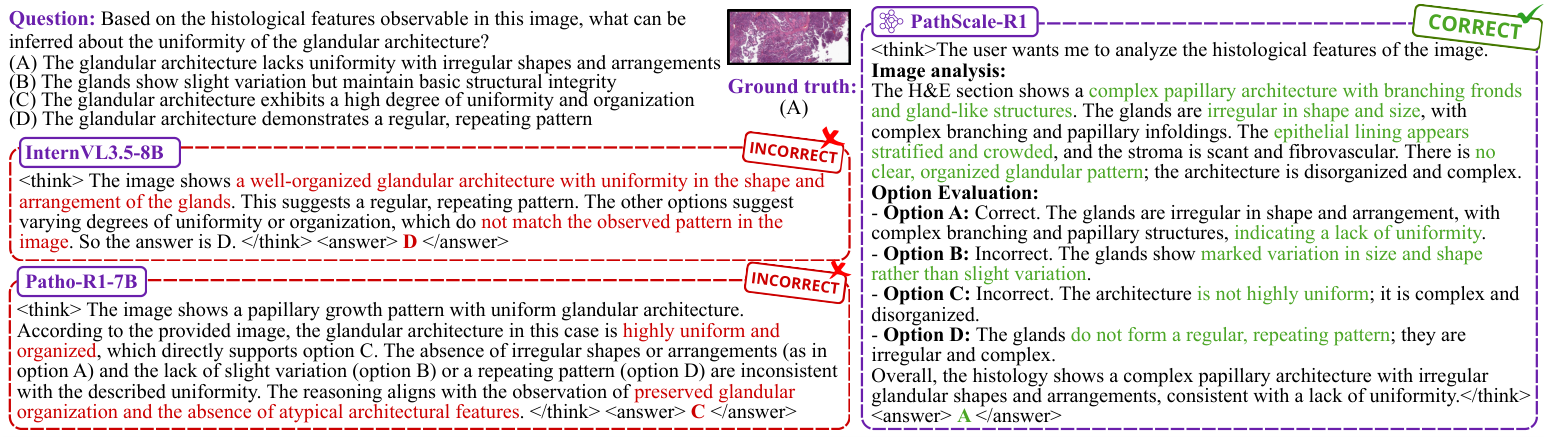
Compare PathScale-R1 with InternVL3.5-8B and the Patho-R1 backbone. Select a case or use the arrows; open either figure for full-resolution reading.
Figure 4. PathScale-R1 connects architecture, stroma, and cellular evidence; comparison models infer unsupported features.Figure 5. PathScale-R1 identifies irregular glandular architecture and grounds the option-level comparison in observed morphology.
1 / 2 · Cross-scale diagnosis
07 / Visual grounding
A remaining challenge for pathology VLMs.
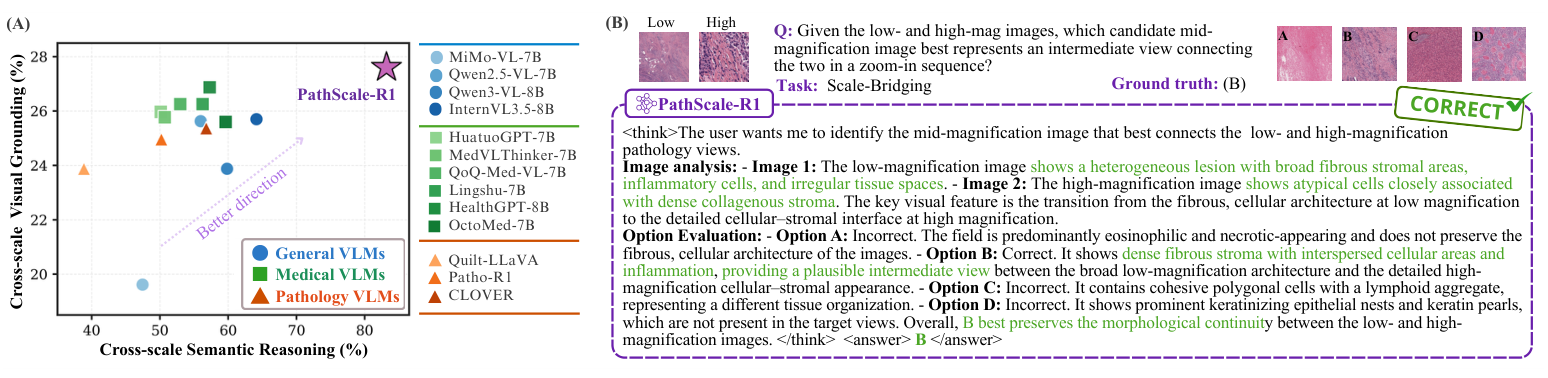
PathScale-R1 achieves the highest grounding accuracy among the evaluated models without grounding-specific training. Yet grounding scores remain low and tightly clustered across models.
Figure 6. Semantic reasoning versus visual grounding performance, and a Scale Bridging example that preserves morphological continuity.
What remains open
The benchmark uses TCGA H&E slides and predefined 10×, 40×, and 200× paths. Broader multi-center data, flexible magnifications, open-ended diagnosis, and interactive WSI navigation remain future directions. Fine-grained spatial correspondence calls for joint semantic and grounding optimization.
08 / Citation
Build on PathScale-R1.
If you use PathScale-R1 or PathScale-VQA in your research, please cite our paper.
@article{phan2026pathscale,
  title={PathScale-R1: Cross-scale Reasoning for Pathological Image Analysis},
  author={Phan, Chi and Zhang, Tianyi and Wu, Yufeng and Xue, Qiaochu and Zhang, Jiajie and Cai, Linghan and Liu, Zeyu and Wang, Sudong and Jin, Yueming and Hu, Dan},
  journal={arXiv preprint arXiv:2607.23794},
  year={2026}
}
Acknowledgements
This work was supported by the Ministry of Education Tier 1 grant, Singapore (24-1250-P0001), and the Ministry of Education Tier 2 grant, Singapore (T2EP20224-0028). This work was powered by the UnPuzzle & PuzzleCloud Platform and supported by PuzzleLogic Pte Ltd, Singapore.